Wednesday, February 10, 2016
2nd Semester Reflection
Because the first semester of US History went well for me, I was feeling very confident going in to the second semester. So far we have been doing a lot of reading and have taken a test. I wish to improve my test scores even more as the semester progresses. In order to improve my test scores I will read over all of the material. I have been pretty consistent with my homework so I would love to keep that up as well. In the future, I plan to read a lot more closely so my reading questions are a lot more accurate. I loved studying documentaries because one of my favorite things to do is analyze film. I enjoy doing this because it gives me a better understanding of the story and also the director/ actors's intensions for the film. I hope to continue to do this as we move on in the semester because I find it very interesting.

Monday, February 1, 2016
Progressive era
1. Progress is the development and growth of something in a positive way.
2. The progressive era is between the 1890s and 1920s . According to gwu.edu, "Progressivism is the term applied to a variety of responses to the economic and social problems rapid industrialization introduced to America. Progressivism began as a social movement and grew into a political movement." That is why this time period is considered the progressive era.
3. Progressive Era Goals/issues:
- Outlaw the sale of alcohol
- regulate child labor and sweat shops
- scientifically manage natural resources
- insure pure and wholesome water and milk
- women's suffrage
- race equality
4. The thing that each one of these things have in common is that they help different types of people in large ways and has a huge impact on everyday life.
5. Essential Goals worth striving for/ Necessary changes: child labor laws, race equality
Good Goals: Women's suffrage, conservation of natural resources, pure water/milk
Strange Goals: outlaw the sale of alcohol
Not a good Idea: outlaw the sale of alcohol
Sunday, January 31, 2016
Progress Classwork
http://www.bbc.com/news/magazine-16444966
http://www.visualnews.com/2012/01/17/scary-accurate-predictions-from-over-110-years-ago/
http://weburbanist.com/2013/05/08/future-past-7-wonders-predicted-100-years-ago/
After doing much research on predictions of the future made one hundred years ago, I found out a lot of interesting information. The predictions made consisted of things like tubes that would shoot hot meals and clothing to homes, flying taxis, the extinction of insects and letters in the alphabet, and also things involving the evolution of humans. In my opinion, the majority of theses predictions seemed to be a "wish list" for those in the past. Many of them such as fishing for seagulls under water and aviary police seemed a bit bizarre, however, some predictions did come true. One of these were being able to talk to humans and not be in the same place but being able to see them. This is what we call FaceTime in todays time period. Also, more accurate predictions include wireless telephones, tanks, the rising height of Americans, pre prepared meals, and much more. There were also many patterns throughout these articles. The most recognizable pattern between each article was that most of the predictions had to do with technological advances. Also, advances in our everyday life such as food and transportation. In the future I see more technological advancement. I believe that we do have some control over the future. There are some things that we cannot control but there are many that we can. The role we play in the future is how to positively advance it and by doing all we can to make it better.
Thursday, January 21, 2016
Eddie Aikau Documentary
The filmmakers named this documentary Hawaiian, The Legend of Eddie Aikau because they wanted him to be recognized as a Hawaiian because a big part of his story was his Hawaiian heritage and culture and how it shaped him. The topic or subject of this film was Eddie Aikau, the focus of this film was the Hawaiian identity and surfing career of Eddie Aikau, and the angle or argument that the film was trying to get across was that Eddie Aikau was the kind of man who believed in keeping Hawaiian culture alive and also believed in protecting the lives around him before protecting his own. I also believe that the film was mainly trying to get across that Eddie Aikau was a man of great honor. Because this film was made as part of ESPN's programming, i think that they filmmakers tried to really put emphasis on the popular Hawaiian sport. This is why they had a lot of facts about the surfing competitions and tied it into how they effected Eddie. If this film was made on a more history based program, I feel that the filmmakers would have put more of a emphasis on Hawaiian culture as a whole rather than just surfing competitions.
"How do you Analyze a Political Cartoon"?
After looking at a guide about analyzing political cartoons, i was familiar with most of the strategies. The ones that I already knew were to look for symbolism, exaggeration, and labeling. The few that I was not aware of included looking for analogy and irony. Going forward, my strategy for viewing political cartoons will remain fairly the same, however, with a few moderations. I will first look at the big picture and then look at the smaller less noticeable things that the author puts in the cartoon. I will then ask questions such as why the author put this there and the importance of each thing. By observing different things, I feel that my analysis will be much stronger.
My Cartoon Analysis:
 This first cartoon was made to show the author's viewpoints on how he felt about the Filipinos gaining independence. The characters are carrying American flags but are clothing that indicates that they are cuban or from the Philippines. I think that they are carrying American flags because America gained independence on the same day and the author wanted to draw attention to the irony of that. This is because this cartoon questions the idea of celebrating the same day as America because sharing a national holiday isn't really independent.
 This cartoon is to represent the Philippine conflict. In this picture I see a Filipino running away from Uncle Sam with a gun in his hand and Uncle Sam chasing him with no weapon in hand. And in the back of the picture is a group of Europeans observing the chase. This picture shows the Americans trying to gain control over them while the Europeans are looking over their shoulder.
 This cartoon is also about the Philippine conflict. The picture shows Uncle Sam welcoming foreign guests into the Philippines after America gained control. The author labels the gates as the Philippines but has Uncle Sam welcoming people as if it were an American thing and not a Filipino thing.
Thursday, January 7, 2016
Phrenology Research
Provenance: the place of origin or earliest known history of something.
Today in class we were presented with an "artifact". Our teacher wanted each of us to observe it and then research our observations in order to find information about the artifact and its origin. The artifact was a bust that had the word phrenology on it. My task was to just record the way my group was researching but I learned a lot just by listening to them.. They researched keywords that were written on the bust such as L.N. Fowler and phrenology, and the different things written on the bottom of the bust in order to find out its place of origin. After researching, we found out that phrenology is a study used in earlier times of the brain. After understanding the definition, my group continued their research by looking up things about the author, L.N. Fowler. While during this research they came across a lot of ads which caused them to speculate if this "artifact" was an actual antique or if it was just a recreation. They eventually learned that it was in fact a recreation of an object used earlier in history by scientist on order to find out more about the brain. Something interesting about the bust was how it was divided. It was divided by using words such as "selfishness" and "love" and other words similar to emotions. Because of this, my group started to wonder why they believed this practice and if this was still practiced today. They found out that it might be possible that it is still practiced in the world but the closest thing the phrenology that is used to day is the study of psychology. This is where my group ended their research. Because I got to observe, I learned a lot about how many students research in order to find something and the importance of paying close attention to details.

Today in class we were presented with an "artifact". Our teacher wanted each of us to observe it and then research our observations in order to find information about the artifact and its origin. The artifact was a bust that had the word phrenology on it. My task was to just record the way my group was researching but I learned a lot just by listening to them.. They researched keywords that were written on the bust such as L.N. Fowler and phrenology, and the different things written on the bottom of the bust in order to find out its place of origin. After researching, we found out that phrenology is a study used in earlier times of the brain. After understanding the definition, my group continued their research by looking up things about the author, L.N. Fowler. While during this research they came across a lot of ads which caused them to speculate if this "artifact" was an actual antique or if it was just a recreation. They eventually learned that it was in fact a recreation of an object used earlier in history by scientist on order to find out more about the brain. Something interesting about the bust was how it was divided. It was divided by using words such as "selfishness" and "love" and other words similar to emotions. Because of this, my group started to wonder why they believed this practice and if this was still practiced today. They found out that it might be possible that it is still practiced in the world but the closest thing the phrenology that is used to day is the study of psychology. This is where my group ended their research. Because I got to observe, I learned a lot about how many students research in order to find something and the importance of paying close attention to details.
Tuesday, December 15, 2015
Entertainment from 1880-1920
The
industrial revolution transformed everyday life in the 19th century. Because
more jobs were available, people were able to have more free time after working
a certain amount of hours a day. This was called leisure time. Leisure time
began to increase and people were able to do more things outside of work to
enjoy themselves. Due to this, entertainment became a major industry. According
to an article on Digitalhistory.com entitled Commercialized Leisure "of all the differences
between the 19th and the 20th century, one of the most striking involves the
rapid growth of commercialized entertainment." It's hard for people
nowadays to think of a life without cell phones and high quality movies, so the
real question is how did people entertain themselves will all of the leisure
time that they had? The answer to this question is pure entertainment. In this
article, it says that before movies happened from 1880 to 1920 people enjoyed
activities including going to theaters, dance halls, circuses, penny arcades,
and organized sports. However, one of the most popular forms of entertainment
back then was Vaudeville and Minstrel shows.
Sources:
Vaudeville was a popular form of entertainment
in the US during this time period. It featured multiple acts that included
burlesque, song and dance. On an article on Virtual Vaudevill.com, it says
that Vaudeville attracted both men and women because there were many
different performance aspects that appealed to both genders. Vaudeville also
attracted young people because they sought pleasure and saw it as an opportunity to explore
freedom without parental control. Vaudeville also consisted of highly diverse short
acts or "turns". These acts included singing groups, animal acts,
comedians, contortionist, magic tricks, and short musical plays. Also, Black face.com notes
that most film stars got their "big break" in Vaudeville. These stars
include Eddie Cantor, Al Jolson, Charlie Chaplin, The Marx Brothers, Jack
Benny, and Bob Hope. Because of the big stars being involved in Vaudeville and
all of the phenomenal acts, Vaudeville became even more popular than before.
But it was not just one race watching Vaudeville. What made Vaudeville so
popular was that it appealed to every race. More specifically it appealed to
African Americas. Vaudeville saw an opportunity to reach out to larger
audiences and so they did, thus the creation of blackface comedy.
According to Black face.com, Black
face played a huge role in the evolution of dance, music, and entertainment as
a whole. Black face changes the face of entertainment because it was the first
time whites ever accepted Blacks on their television screens. After researching
an article on Wikipedia about Black
vaudeville
and black-facing, it was revealed that most African Americans got
into black vaudeville because it was better than working as a maid or in a
field. It also said that it was very difficult for black to be accepted on a tv
screen with other white people. But it was okay because other blacks enjoyed
being able to watch and enjoy entertainment that they could relate to
regardless of the racist stereotypes. So what it is Black-face comedy in
Vaudeville exactly? According to Black face.com, it is when both white and
black people take a layer of burnt cork, cocoa butter, or black grease paint,
and cover their entire faces with it. They also drew big round lips around
their original mouths to mock the face of a black person. The shows illustrated
"blackness" while making jokes on common stereotypes. Black
performers even painted their faces even darker than their original skin tone
because most American believed that the darker you skin was, the more
uncivilized you were. This relates to both house slaves being lighter skinned
than the slaves that worked in the field. On an article on UsFacingGrace.com
entitled Vaudeville and the American
Entertainment Industry, there were many terms that
were used later in film as characters that originated from these Minstrel Shows
such as Jim Crow, Zip Coon, Mammy, Uncle Tom, Buck, Wench, Mulatto, and
Pickanniny. All of these characters were based on stereotypes that were derived
all the way back from slavery. Black face in Vaudeville also produced many
African stars such as William Henry Lane aka "Master Juba", whom was
one of the first African American blackface performers and also the inventor of
tap dancing. However, One of the most famous and influential Black- performers
of her time was the one and only Sissieretta Jones.
Sissieretta
Jones was an African American opera singer. A Newspaper Article in The Seattle Republican
written on March 08, 1907 says, "Miss Jones is a singer with a large
reputation and is herald as being the greatest of her race." Being apart
of a newspaper as an African American with this sort of recognition was a big
deal at the time and still is today. Sissieretta Jones was known as the
original "Black Patti". According to an article on History.com
entitled 10 19th century celebrities you should know, Jones had the capability to headline operatic
productions all around the world, but was not able to because she was black.
Jones was the first African American to sing at the Music Hall in New York
(today known as Carnegie Hall). She received raving reviews from powerful
people such as multiple presidents. However with all of this fame and
recognition, she was never offered an opportunity to make it big time. She sang
and traveled all around with Vaudeville shows and her group, Black Patti
Troubadours, and ended up being the highness paid black performer of her time.
A book entitled The Early Life and Career of the "Black Patti":
The Odyssey of an African American Singer in the Late Nineteenth Century, she was
noted to have a long career compared to most African American performers. This
shows because her talents were respected everywhere by many people but not
enough. Jones ended up dying without any money and having never been casted in
a professional company.
During all this research the one question that repeatedly came up was why did African Americans put up with all of
this racial hate and stereotyping, unfairness, and low pay? Why did they accept
this? The Early Life and Career of the
"Black Patti": The Odyssey of an African American Singer in the Late
Nineteenth Century says that Sissisiertta Jones was compared to
multiple famous opera singers. And most of their hits came from using black
stereotypes as comedy to make money. I was confused and frustrated and they it
finally hit me. Although African Americans were being mistreated, they realized
that this was the only way to showcase what they love to do. Preforming is a
passion and you cannot half way do it. It's an all the way or not at all kind
of thing. Part of being a performer is putting up with hate, bullying, and
criticism. But if you are doing what you love and you are happy, then there is
no point on dwelling on the bad. These performers thought that this was the
best that it was ever going to get for them so they put up with it and they
were happy.
Thanks to leisure time, entertainment was
allowed to flourish and grow and create new things. Because of these new
opportunities were created for every one of all races and genders. Vaudeville
was revolutionary because it gave opportunities to multiple performers and
produced many famous performers that are still talked about today. Vaudeville
and minstrel shows has also affected the way we view entertainment today
because shortly after movies began to be created and a whole new era of
entertainment began.
 |
| This is a picture of a contortionist act in a Vaudeville show. One big change that happened at the start of live shows was Coney Island, a huge amusement park that had multiple sows. |
 |
| This is a picture of one of the most famous and influential Vaudeville performers, Charlie Chaplin. Chaplin began his debut as an entertainer in Vaudeville and later started working on film as movies became more popular. |
 |
| This is a poster that was used to advertise one of the blackface and minstrel shows in Vaudeville. White actors would often paint their faces black in order to act as the stereotypical black man or woman at that time period. |
 |
| This picture is another example of white people black facing themselves for shows. |
 |
| This is a picture of Jim Crow, one of the commonly used African American stereotypes used for characters. |
 |
| This is a picture of Buck, another black character stereotype used in Blackface. Buck was a proud black man who was attracted to white women. |
 |
| Mammy is another stereotype used in blackface. Mammy is the "strong independent black woman." |
 |
| This character in blackface is referred to as Uncle Tom. Uncle Tom is the old man who often gives wise advice to the other characters in blackface. |
 |
| This is a picture of the character who is called Wench. A wench is a man dresses as a woman whom seduces the characters. |
 |
| This is a picture of a pickaninny. A pickaninny is a chid character in blackface who has messy hair and loves watermelon. |
 |
| This character is named Zip Coon. Zip Coon is a character in blackface that represents the free blacks during slavery. Zip Coon wore lavish suits and talked like a gentleman. |
 |
| This is a picture of the blackface character who is often referred to as Mulatto. Mulatto is a light- skinned African American who tries to pass as a white person. |
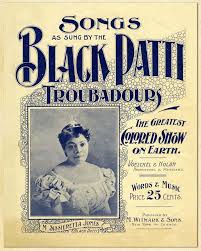 |
| This is a picture of a flyer that is advertising for Sissieretta Jones' group: Black Patti Troubadours. |
 |
| Sissieretta Jones; the most iconic African American female artist of her time. |
 |
| Sissieretta Jones or "Black Patti" |

Sources:
I used this website to provide me with other resources in order to find information about my topics.
I used this book on Jstor as a starting point within my research of Vaudeville. It gave me tips on what to search for and what I wanted to write about.
I used this website to get a better understanding of why entertainment was used during leisure time and how it effected the people. I also pulled quotes from this website.
I used this website to gain a general knowledge of Vaudeville and to find specific points that I wanted to expand my research on.
After researching vaudeville, I I found the information about African American performers in Vaudeville very interesting. This website gave me the basics to that information.
I used this website because it gave me most of the information I needed to know about the history of black face in America.
This website gave me all of the information I needed on the stereotyped characters in Vaudeville.
This newspaper article was a great source for quotes that were authentic because it was written by people living at the same time as Sissieretta Jones.
This website helped me find the most influential celebrities of the 19th century such as Sissieretta Jones.
This chapter in this book found on Jstor gave me information about Sissieretta Jones' legacy as a singer in her era.
This chapter in this book found on Jstor gave me information about Sissieretta Jones' early life and career as an African American performer.
Subscribe to:
Posts (Atom)